
You usually feel it before you see it. A soft dip underfoot near the pool. A patio chair that won’t sit flat. A railing line that doesn’t look quite as straight as it did a few summers ago.
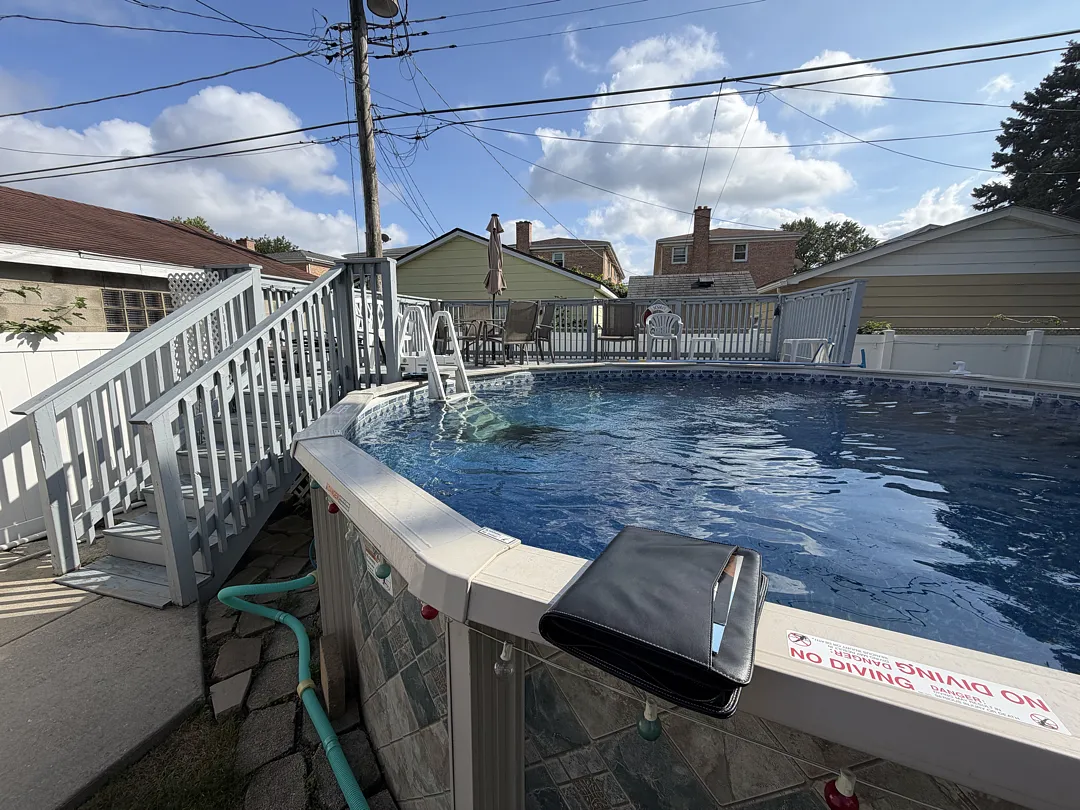
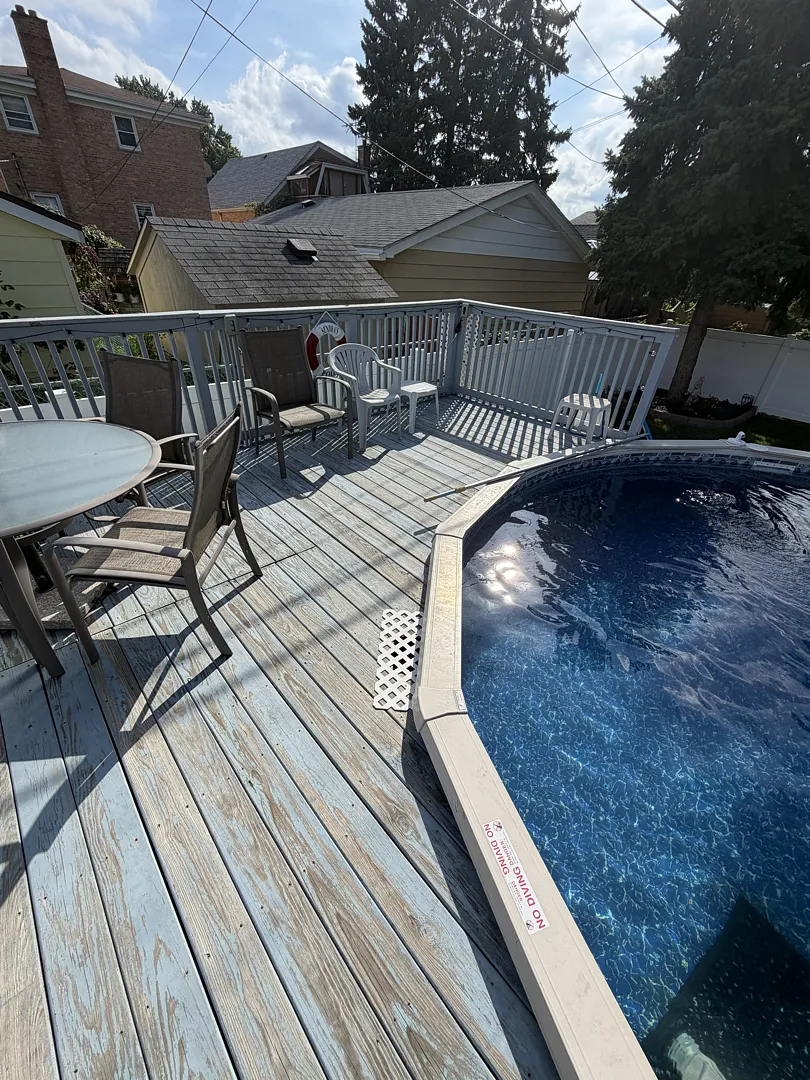
On a 250 sq ft pool deck on W Gunnison St, that dip came down to one part: a single 4×4 support post had settled, and the deck framing it carried dropped with it. This is one of our newest projects, finished in early October 2026, and it is a good example of a repair most homeowners don’t know is possible. You don’t need to tear out a deck because one corner went soft.
This write-up follows the job the way we worked it. First what the homeowner saw, then what we checked under the deck and how we raised it. After that, what this kind of repair costs at our rates and the limits we explain before anyone picks up a jack.
Project File: W Gunnison St, Chicago, IL 60630
| Location | W Gunnison St, Chicago, IL 60630 — Chicago’s Northwest Side |
| Deck | 250 sq ft wood pool deck built around an above-ground pool, with stairs and a full railing |
| Problem | One 4×4 support post had settled, letting the framing around it drop and leaving a noticeable low area in the deck |
| Repair type | Localized substructure repair: raise, stabilize and re-secure the affected section |
| Materials | No major materials. Minor structural fasteners and hardware only |
| Completed | Early October 2026 |
Photos are from the job site. We share the street, not the house number, to respect the homeowner’s privacy.
What Did the Homeowner Notice — and What Did We Look For?
A sunken spot on a deck can mean very different things. Sometimes a single board has cupped. Sometimes a post, a beam or a whole footing has moved. From the top the two can look much the same. So the first visit is about separating what you see on the surface from what is happening underneath.
| What homeowners usually notice | What we check before quoting |
|---|---|
| A low area or dip in the deck surface this was the sign on this deck | Whether the framing has dropped or only the boards. A dip that runs across several boards points to a post or beam, not the decking. |
| Furniture that rocks, or a spot where water sits after rain | How far the low area spreads, and which post sits under it. |
| “Is the whole deck going?” | The other posts, the beam, joist hangers and connections. One settled post on a sound frame is a repair. Several are a different conversation. |
| A deck built tight against the pool | Clearance to the pool wall, and where pool equipment, plumbing, electrical and gas lines run through the space we need to work in. |
On this deck the inspection pointed to one place: a 4×4 support post that appeared to have settled, pulling the framing above it down and creating the dip. The rest of the frame was in condition to be adjusted rather than rebuilt. That is what made a targeted repair the right call.
Why Do Deck Posts Sink in Chicago?
A post doesn’t sink on its own. Whatever it stands on moves first. These are the most common reasons we see:
- Soil that keeps settling. Backfill around homes and pools compacts for years, and a post resting on it goes down with it.
- Freeze and thaw. Chicago soil heaves in winter and softens in spring. Footings that sit above the local frost line (about 42 inches deep around here) get pushed and dropped every season.
- Extra water at pool decks. Splash-out, draining and wet feet keep the ground under a pool deck damper than under most decks, and wet soil carries less load.
- Small or shallow footings. A post set on a paver, a loose block or a thin pad has very little bearing area to spread the weight.
The American Wood Council’s DCA 6 deck construction guide is the reference most inspectors and builders use for footing sizes, post sizes and how posts tie into beams. Many older backyard decks were built before anyone checked them against it. When we find a sunken post, the footing is the first thing we ask questions about.
Timing matters too. A dip rarely gets better over a winter. Freeze-thaw tends to make a moving post worse, which is why fall is when we push structural checks. It’s part of getting a deck ready for winter, not just a spring job.
Under the Deck: The Space We Had to Work In
Pool decks are tight underneath. This one had the pool wall on one side, lattice skirting around the outside and a yellow gas line running through the framing. Old patio slabs sat on the soil below, so there was very little room for jacks and supports.
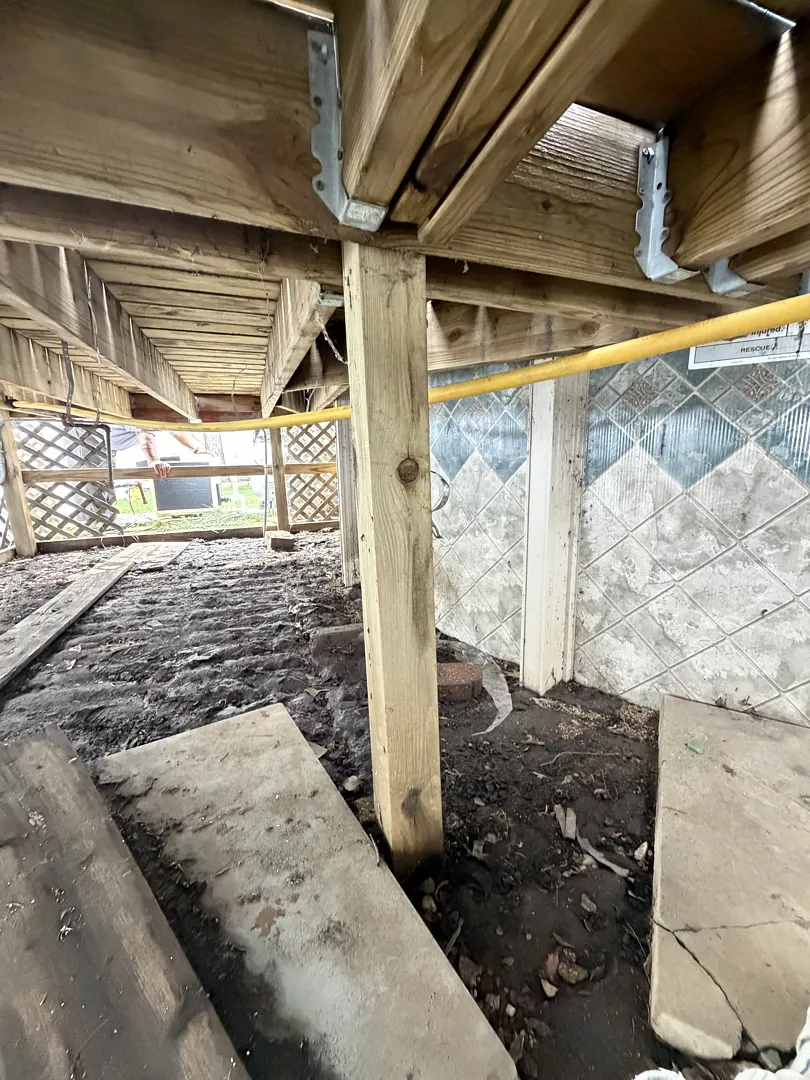
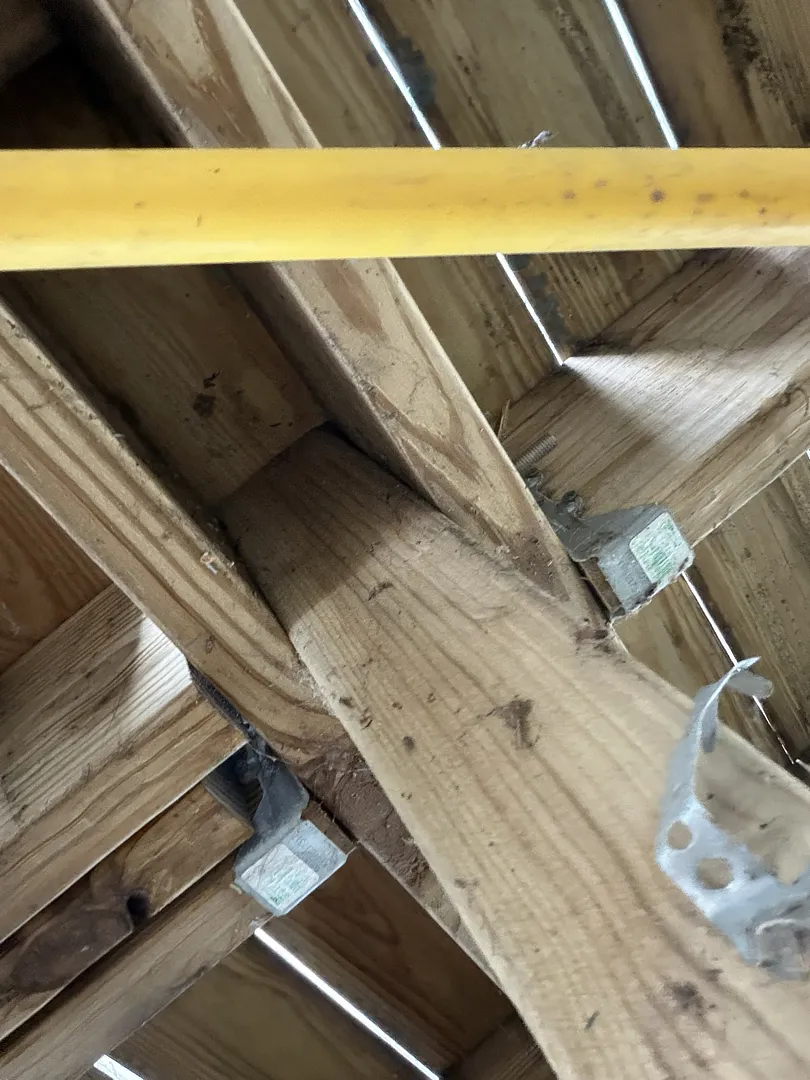
Those photos show why we don’t treat a sunken post like a weekend job. Lifting framing next to a gas line and a pool wall has to be slow and controlled. Every jack has to be placed so nothing else gets pushed out of position. Utilities and pool equipment stay as they are. Our scope covers the deck structure only, and anything else is left alone unless the homeowner agrees otherwise.
This is the kind of work that sits inside our deck restoration and structural repair service. It’s a small fix compared to a rebuild, but it is still structural.
How We Raised It, Step by Step
Every leveling job starts the same way: control the load first, then move the wood.
1. Get access and check the connection
We opened up access to the substructure and looked at how the post was tied into the framing before touching anything. That connection decides how the post can be freed and re-secured.
2. Put temporary support under the low section
Temporary supports and jacks went in under the affected framing so the deck was held up by something we control, not by the settled post.
3. Free the 4×4 from the framing
The post was freed or disconnected from the surrounding framing as needed, so the deck could be adjusted without dragging the post up or down with it.
4. Raise it in small steps
We brought the framing up gradually, a little at a time, toward where it belongs. We stop at the point the existing structure allows, which is as close to level as the deck can reasonably get.
5. Re-secure the post
Once the framing reached an acceptable final position, the existing 4×4 was put back in place and fastened to the framing again.
6. Replace tired hardware
Minor structural fasteners and hardware were installed or replaced where needed. Simpson Strong-Tie’s deck connector guide is a useful look at why the right corrosion-resistant hardware matters, especially near pool water.
7. Pull the supports and inspect
Temporary supports came out once the post was carrying the load again, and we finished with a visual inspection of the adjusted area.
From Our Side: Why We Don’t Promise “Perfectly Level”
This is the part of the job we explain before we start, because it is the part people don’t expect.
Raising a settled deck is a corrective repair to an existing structure. It is not a reconstruction. When framing has sat low for a while, the lumber, fasteners, decking and railings have all adjusted to that position. Lifting it back puts movement and stress on every one of them.
What we put in writing on every leveling quote:
We work gradually and with care, but cracking, splitting, shifting, separation or fastener movement can happen as settled parts are moved back.
We can’t guarantee a deck goes back to perfectly level or its original position. The final height depends on the condition, construction and limits of the existing deck.
If we find more problems along the way, such as a weak footing, ongoing settlement, rotted lumber, failed connections or the need for more posts, we stop and talk it through before going further. Any extra work is quoted separately.
We would rather set that expectation up front than have a homeowner find a split board and wonder what went wrong. On this job the goal was clear from the start: bring the low section up as close to level as the structure allows, and make it stable again.
What Does It Cost to Fix a Sinking Deck Post?
Structural repairs are priced by the work involved, not by square foot. These are the ranges we use for deck repair costs across the Chicago area:
| Repair level | What it usually covers | Typical range |
|---|---|---|
| Minor repair | Loose or damaged boards, fasteners, small fixes on a sound frame | $50–$500 |
| Post or joist repair where this project falls | Raising and re-securing a settled post, sistering or fixing a joist, replacing connectors | $300–$2,000 |
| Full replacement | Widespread rot, failing framing, or a new design | $3,000–$15,000+ |
Ranges at our standard rates. Every repair is confirmed after an on-site inspection.
Why this project sits in the post/joist band: one settled post, temporary support and jacking, careful step-by-step lifting in a tight crawl space next to a gas line, and minor hardware. No new lumber or concrete was planned.
What pushes the price up:
- A new concrete footing or post block. If the soil under the post keeps moving, the lasting fix is a new footing, and that is quoted separately.
- More posts, blocking or framing changes. Problems that show up once the deck is lifted.
- Rotted or split lumber. Replaced only with your approval.
- Hard access. Pool walls, skirting, equipment and utilities all slow the work down.
Any repair that needs a new footing means digging, and digging means a utility locate first. Inside city limits that is 811 Chicago. In the suburbs it is JULIE. On a lot with a gas line running under the deck, that step is not optional.
Repair, New Footing or New Deck — Where Is the Line?
Most homeowners we meet with a sunken deck expect to hear “rebuild.” Usually that isn’t the answer. This is how we sort it:
- One post settled, frame is sound: raise, re-secure and stabilize, like this project.
- The post keeps sinking because the footing failed: raise the deck and add a new footing under that post.
- Several posts moving, rot in the beams or joists, or failed connections: at that point repairs stop being good value.
For the third case, our guide on when to repair, refinish or rebuild walks through the same decision on a bigger scale. When a frame is truly done, we move on to building a new deck on proper footings instead of patching the old one again.
What This Deck Needs Next
With the framing back up, the surface is the next thing to look at. The decking on this pool deck has gone gray and the old finish has worn thin, which is normal for boards that live next to pool water and full sun.
The order matters: fix the structure first, then refinish. Staining a deck with a dip in it just puts new color on a problem. With the frame stable, the boards are ready for deck staining when the weather allows. It is also worth keeping an eye on the repaired area after its first winter, the season that shows whether the ground under a post has settled down.
Questions We Get About Sinking Decks
Can a sunken deck be leveled without rebuilding it?
Often, yes. If one post has settled and the rest of the frame is sound, the low section can be held on temporary supports, raised gradually and re-secured. That is what we did on this Chicago pool deck. A full rebuild only makes sense when several posts are moving or the framing itself has failed.
How much does it cost to fix a sinking deck post in Chicago?
At our standard rates, a post or joist repair typically runs $300 to $2,000. A single settled post with minor hardware usually sits within that range. A new concrete footing, extra posts or replacement lumber are quoted separately after we see the field conditions.
Why do posts sink under pool decks?
The soil under a pool deck usually stays wetter than under other decks, from splash-out and draining. Add Chicago’s freeze-thaw cycles and footings that are small or shallow, and the ground under a post can compress or shift. The post, and the framing it carries, follows it down.
Can raising a deck damage it?
It can. Lifting framing that has settled puts stress on lumber, fasteners, decking and railings. Some cracking, splitting or shifting is possible even when the work is done slowly. A good contractor will tell you that before the job, and will not promise a perfectly level result.
Do I need to call 811 before fixing a deck post?
Only if the repair involves digging, such as a new footing. Inside the City of Chicago, locate requests go to 811 Chicago. In the suburbs, call JULIE at 811. Raising and re-securing an existing post without digging does not need a locate.
Noticed a dip, a lean or a soft spot in your deck? We have been working on Chicagoland decks since 2009, and every repair starts with a free on-site look at what is really happening underneath. Book an estimate or call us on (630) 984-6116.