
A homeowner on N Merrimac Ave had a good problem. Part of their backyard fence had just been rebuilt in fresh cedar, bright and clean, sitting right next to older sections that had already been stained years ago. The new wood looked great for about a week. They knew what came next: gray, then blotchy, then a fence that looked like two different fences.
They called us to wash and seal the new sections before that happened — and to make them sit as close to the old color as wood allows. Below is the whole job: what we found, how we washed it, what went on it, what it costs at our standard rates, and the one thing we tell every homeowner before new and old wood get the same stain. If your fence needs more than a wash and seal — leaning posts, rot, a sagging gate — that is a full fence restoration, and it is priced differently.
The Job at a Glance
| Location | N Merrimac Ave, Chicago, IL 60646 — on Chicago’s Northwest Side |
| Fence | 6-ft cedar privacy fence on black steel posts, enclosing the backyard |
| Scope | New cedar sections only, both sides, plus the gate shared with the neighbor — interior and exterior |
| Surface area | About 780 sq ft of fence face (roughly 65 linear feet, both sides) |
| Process | Cleaner, power wash, wood brightener as needed, then one coat of oil-based semi-transparent sealer |
| Product & color | TWP 1500 Series, Rustic, matched as closely as possible to the older stained sections |
| Completed | September 20, 2026 |
Photos are from the job site. We share the street, not the house number, to respect the homeowner’s privacy.
Before: New Cedar Still Needs Washing
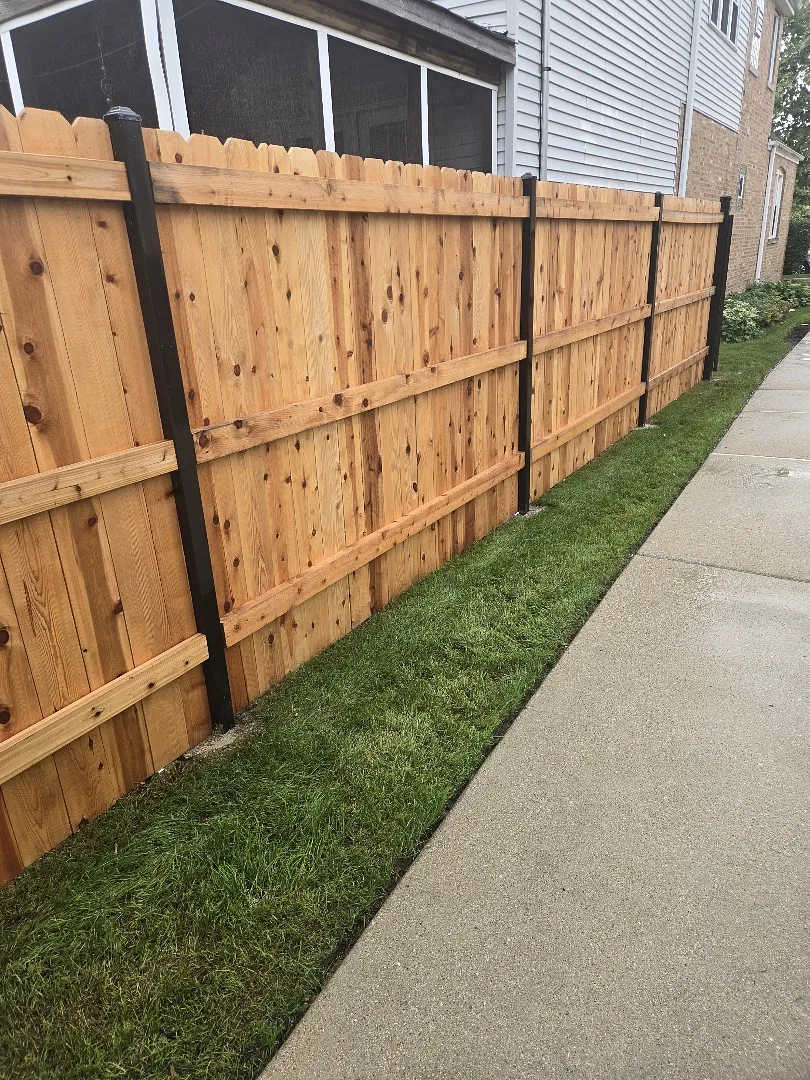
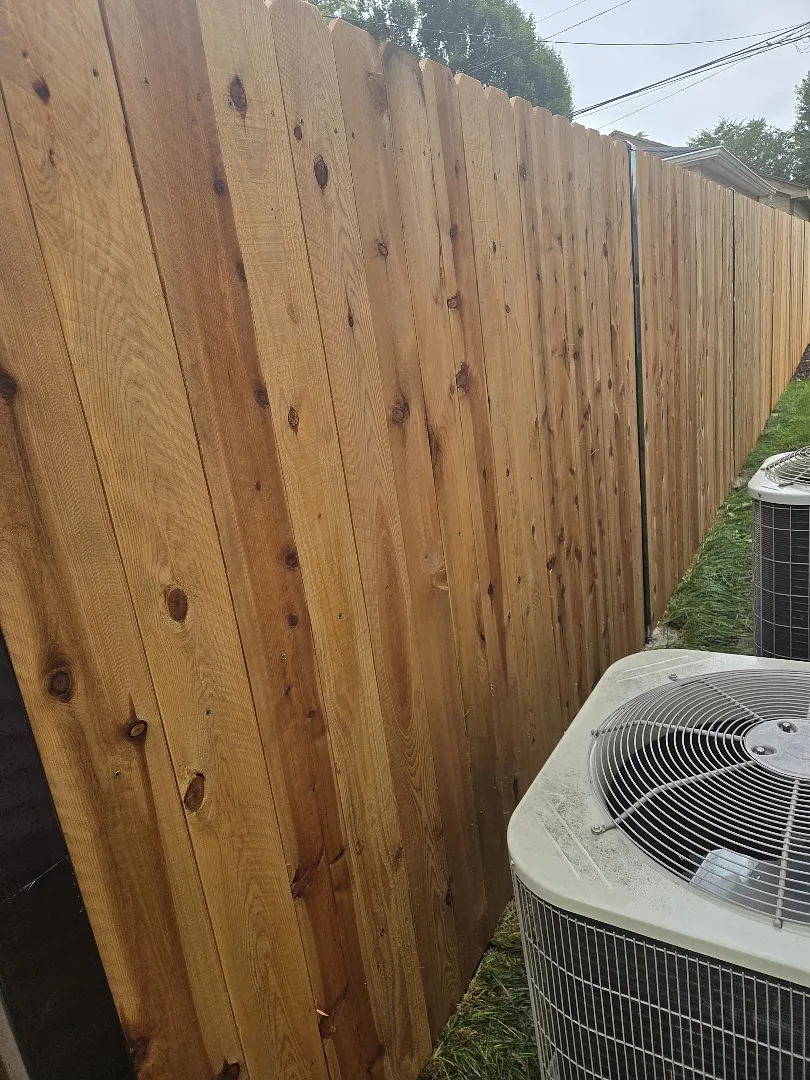
The most common question on a job like this: “It’s brand new — why wash it?”
Because new is not the same as clean. Between the lumber yard, the install and a few weeks outdoors, fresh cedar picks up sawdust, handling marks, pollen, grass clippings from the mower and the first traces of mildew. Every one of those sits between the stain and the wood. Seal over them and the finish bonds to the dirt instead of the fiber, which is how a new fence ends up blotchy in its first year.
The photos above were taken right after the wash. That even, pale tone with no gray and no dark smudges is what a fence should look like before any sealer touches it.
Step 1: Cleaner, Power Washing and Brightener
Our process starts with a wood cleaner, then a power wash to take the dirt and grime off both faces of every picket, rail and brace. Where the wood needs it, we follow with a brightener. Cleaners lift dirt and mildew. Brighteners bring back the wood’s natural tone and neutralize the cleaner so the stain goes onto an even surface. The USDA Forest Products Laboratory’s chapter on finishing wood covers why exposed wood surfaces degrade and why cleaning comes before any finish.
It is the same wash-first sequence we use for deck sealing, with two fence-specific differences:
- Pressure stays low and the tip stays moving. Cedar is soft. Too much pressure raises the grain and leaves wand marks that show straight through a semi-transparent stain.
- Both sides mean two properties. This fence encloses the yard, and one gate is shared with the neighbor, so their side gets washed too. That is why our quotes ask the homeowner to let adjacent neighbors know the project dates ahead of time.
Then the wood has to dry. Nothing goes on damp cedar — sealing in moisture is the fastest way to a finish that never looks even.
A note we put in every fence quote: power washing can uncover soft or rotten boards that were not visible at the estimate. When that happens, we stop and tell the homeowner before sealing. We strongly recommend replacing rotten wood first, because stain does not fix rot — it just colors it. Replacement is quoted separately, only with the homeowner’s approval.
Step 2: One Coat of Oil-Based TWP 1500
For this fence we used TWP 1500 Series in Rustic, an oil-based semi-transparent stain and EPA-registered wood preservative. Three reasons it fit this job:
It penetrates instead of forming a film. Oil-based semi-transparents soak into the cedar and harden inside it, so there is nothing to peel or flake later. The Western Red Cedar Lumber Association’s guidance on finishing cedar outdoors makes the same call: oil-based stains outlast latex on cedar, and latex forms a film instead of penetrating.
One coat is the right amount on new wood. Fresh cedar can only absorb so much. TWP’s own directions call for one coat on new wood. A second coat would sit on the surface and stay tacky instead of soaking in. Weathered wood is different and often takes two coats applied wet-on-wet.
It was the closest match to the older sections. The rest of the fence already carried an older coating, and Rustic gave us the nearest tone. TWP 1500 is one of the stains we reach for on fences and vertical wood — the full list, and why each earned its spot, is on our products we use page.
One detail that is easy to miss in the photos: the posts are black steel. We kept the stain on the cedar pickets, rails and braces and cut in cleanly along every post, so the black frame still reads crisp against the new color.
After: The Result — and an Honest Word on Color Matching
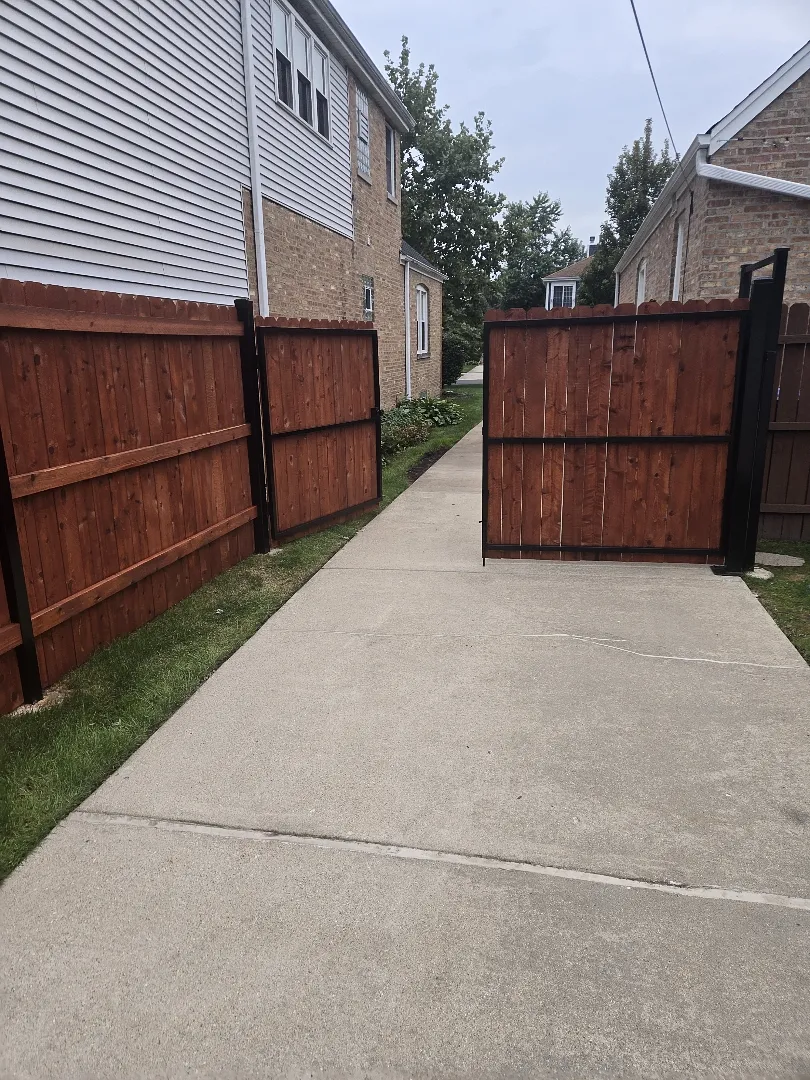
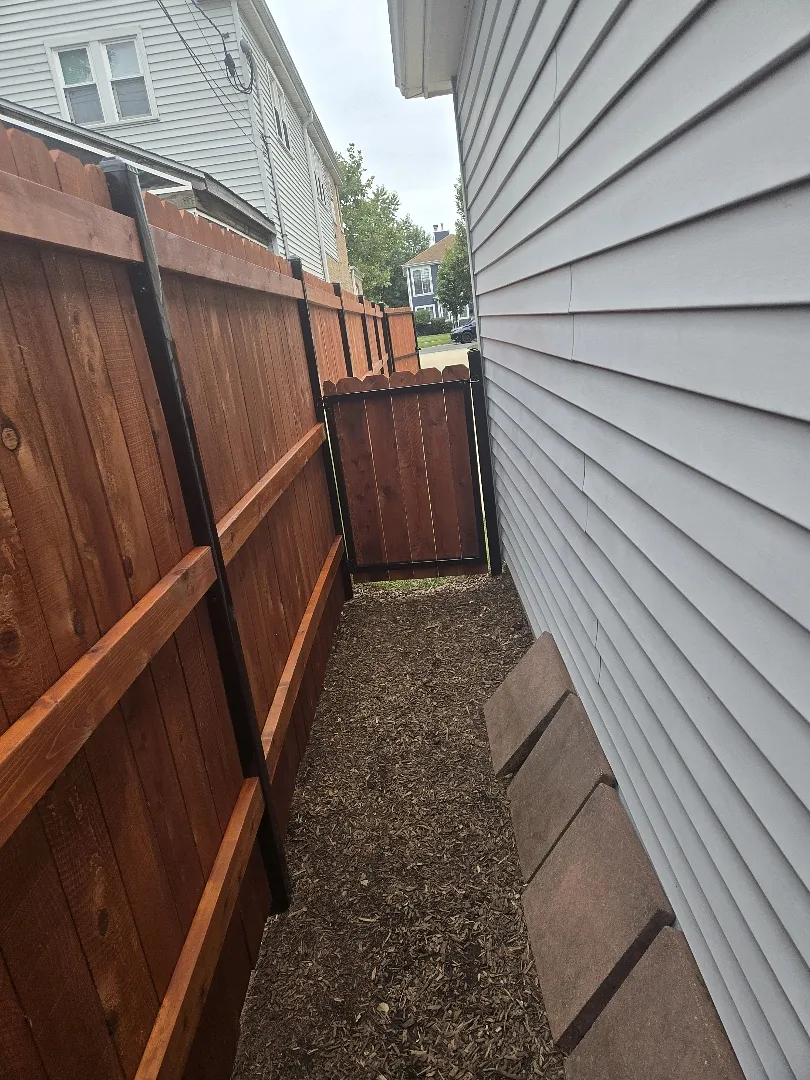
The fence went from raw, pale cedar to a warm reddish-brown that sits close to the older sections. We are always straight with homeowners about what “close” means. New and existing fence sections are never an exact match, even with the same stain, because they differ in:
- Wood age — fresh cedar absorbs stain differently than boards that have weathered for years.
- Existing coating — older sections carry whatever formula was used before, and it has faded unevenly.
- Absorption — even boards from the same pallet take stain differently.
- Knots and hard grain — these resist penetration and can stay lighter after application.
Expect some variation in color, tone and sheen, especially in the first season. Most of it evens out as the new finish weathers in alongside the old. That is what this job was designed for: a color reasonably close in tone, not an invisible seam.
What This Fence Job Costs at Our Rates
Fence refinishing is priced by the length of the run, not by the hour. Our standard rate for cleaning and refinishing a wood fence on both sides is $3 to $8 per linear foot, materials included. Here is how this job works out:
| Line item | Basis | Estimate |
|---|---|---|
| Wash, brighten & seal, both sides cleaner, power wash, brightener, one coat TWP 1500 | ~65 linear ft × $8 | ~$520 |
| Neighbor’s shared gate, both sides | Included in the run | Included |
| Stain, cleaner, brightener, brushes & prep supplies | Included in the per-foot rate | Included |
| Estimated total | ~$520 |
Estimated at our published rates. Every fence is confirmed after an on-site inspection, and a 30% deposit reserves the date.
Why this one sits at the top of the range: both faces of the fence, a neighbor-side gate, a brightener step, a premium oil-based preservative, careful cut-in along steel posts, and color matching against older sections. A simple one-sided wash and clear seal on an open run lands closer to $3 per foot.
What is not in that number:
- Rot found during washing. Replacing a warped or rotten picket runs $6–$18 each, and a rail $25–$75, quoted only after we show you what we found.
- Plant removal, tree trimming or landscaping. Vines and shrubs growing into the fence have to be cleared first, and charges may apply if they block the work.
- Structural work. Leaning posts and gate repairs are priced per item on our fence restoration page.
What Moves a Fence Sealing Price Up or Down
Here is how we look at a fence when we quote one, so you can size up your own before you call:
- Length and height. Linear feet sets the base. A 6-ft privacy fence has far more surface than a 4-ft picket fence of the same length.
- One side or both. Both sides roughly doubles the surface. If the other side faces a neighbor, access has to be arranged.
- Condition. New or recently cleaned wood takes one coat. Gray, weathered wood needs heavier cleaning, brightener and usually two coats.
- Style. Shadowbox and board-on-board fences have more edges and gaps to work stain into than a flat privacy fence.
- Access. Tight side yards, AC units against the fence and plantings all slow the crew down. Clear them before the crew arrives.
- Product. An oil-based preservative costs more per gallon than a basic water-based sealer, and lasts longer on a vertical fence.
DIY vs. Hiring a Crew
A fence is one of the more DIY-friendly wood projects, and we say that as the people who get hired to do them. What catches people out is the math. TWP rates the 1500 Series at roughly 150–200 sq ft per gallon, so a fence like this one — 780 sq ft across both faces — needs four to five gallons of stain alone. Add cleaner, brightener, a pressure washer, sprayer or brushes, drop cloths and a weekend or two of dry weather.
The bigger risks are not cost:
- Too much pressure leaves wand marks that show through a semi-transparent finish for years.
- Sealing damp wood traps moisture and gives you blotches.
- Over-applying on new cedar leaves a tacky surface that never cures.
- Overspray on siding, steel posts, cars and the neighbor’s side of the fence.
If you are weighing the two, our restoration cost and DIY guide walks through the same trade-offs for decks, and most of it applies to fences too.
How Long a Sealed Fence Lasts — and When to Reseal
Fences hold a finish longer than decks. They are vertical, so water runs off instead of pooling, and nobody walks on them. On a Chicago fence with an oil-based semi-transparent, we usually plan a maintenance coat every 3 to 4 years, sooner on runs that face south or west and bake in the afternoon sun.
The signs are the same ones we look for on a deck: water soaking in instead of beading, color fading unevenly, and gray creeping back at the tops of the pickets first. Our guide to how often to restain covers those signs in more detail. The good news with a penetrating oil is that the next round is a clean-and-recoat, not a strip-and-start-over.
What the Homeowner Handles Before We Arrive
This comes straight from the scope of work on every fence quote we write:
- Clear anything leaning against or stored near the fence.
- Let adjacent neighbors know the project dates, and arrange access if we need to work on their side.
- Make sure an outdoor water source and power outlet are available and working for the whole project.
That is it. We handle the washing, the brightener, protecting nearby surfaces, the stain and the cleanup.
Frequently Asked Questions
How much does it cost to power wash and seal a fence in Chicago? Cleaning and refinishing a wood fence on both sides typically runs $3 to $8 per linear foot, materials included. The 65-linear-foot cedar privacy fence in this article, with a shared gate, works out to about $520 at the top of that range. Most homeowner fence projects land between about $500 for a light refresh and $2,000–$3,000 or more for long runs that also need repairs.
Should you power wash a new cedar fence before sealing it? Yes. New cedar picks up sawdust, handling marks, pollen and early mildew between the lumber yard and the first few weeks outdoors. A low-pressure wash, plus a brightener where needed, gives the stain clean wood to bond to. Let the fence dry fully before sealing.
How many coats of TWP 1500 does a new fence need? One. New wood can only absorb so much, and TWP’s directions call for a single coat on new wood. Older, weathered wood often takes two coats applied wet-on-wet.
Will new fence sections match the old ones after staining? Close, but never exact. Wood age, the old coating, absorption and knots all change how stain looks. A good contractor will choose a color reasonably close in tone and tell you up front to expect some variation in color and sheen. Most of it evens out as the new finish weathers.
How long does a sealed wood fence last before it needs another coat? With an oil-based semi-transparent stain, plan on a maintenance coat every 3 to 4 years in the Chicago area. Sun-facing runs may need it sooner. Because the finish penetrates rather than forming a film, the next round is a clean-and-recoat, not a strip.
What happens if rotten boards are found during washing? We stop and show the homeowner before sealing. Replacement is recommended, because stain does not fix rot. Pickets run $6–$18 each and rails $25–$75, quoted separately and done only with your approval.
Got a new fence, or an older one going gray? We have been finishing Chicagoland wood since 2009, and every quote starts with a free on-site visit. Book an estimate or call us on (630) 984-6116.