
“Can you still get to my deck before it gets cold?”
That call starts coming in early September and does not let up until the leaves are down. Sometimes it is a homeowner who watched their boards gray out over the summer and is suddenly picturing snow on bare wood. Sometimes it is a family that finally got around to it. Either way, our answer is not automatically yes. There is a point in the fall where we stop putting stain and sealer on decks in Chicagoland, and we would rather say so up front than take a deposit for a coat that will not cure. Here is the number we watch, why it beats any date on the calendar, and what we can still do when deck staining has to wait.
We Watch the Overnight Low, Not the Calendar
People ask us for a last date. There is not one. What governs a finish is the temperature of the wood itself, for the full day or two after we apply it.
As a rule, once the ten-day forecast shows overnight lows sitting below 45°F, we usually stop scheduling new stain and seal work. That is less a wall than the point where we start being careful — a sheltered, south-facing deck in a mild stretch can still take a coat when a shaded north-side deck two towns over cannot. If you are anywhere near that line, call us before you write the season off. We will look at your real forecast and your real boards and tell you which side of it you are on.

The reasoning is simple. Daytime highs are misleading: a deck can read a comfortable 60°F at two in the afternoon and be down to 38°F by five the next morning, and the finish is still curing through every hour of that. Penetrating oils need warmth to work into the grain and time afterward to harden — our guide to deck stain drying and curing times breaks that down by finish type. Too cold and the oil sits on top instead of soaking in — tacky for days, marked up by the first person who walks on it, and defenceless against the first rain.
There is a moisture side too. Chicago autumn air is damp, dew sits on boards until mid-morning, and wood that feels dry underfoot can still be carrying water. Finish that surface and you seal the water in rather than out. The same physics governs deck sealing, which is why we treat the cutoff as part of planning a deck restoration, not a scheduling detail.
Your Real Deadline Depends on Which Suburb You Live In
“Get it done before the first freeze” is the advice everybody gives. It is not wrong, but it is not one date across the area we cover.
The National Weather Service publishes first freeze normals for our region using 1991–2020 data: the normal first 32°F night at O’Hare falls on October 19, while Rockford reaches it on October 13. Nearly a week of spread inside one metro area. Homes near the lake, where the water holds heat well into fall, get a longer working window than families out in DuPage and Kane.
So we do not publish a single book-by date — we would be wrong for half our customers. A Wilmette deck and a West Chicago deck are on different clocks.
Three Free Things Worth Doing Before You Call Anyone
Before you pay anybody — us included — there is work that costs nothing and matters more than most homeowners expect.
1. Get the leaves off, and keep them off. This is the highest-value free thing you can do in fall. Wet leaves trap moisture against the wood and leach tannins that stain it dark. A ten-minute sweep every week or two through leaf-drop prevents damage that costs real money to sand out later. Watch the corners, the gaps between boards, and anywhere against the house.
2. Run the water test. Splash a cup of water across a few areas. If it beads and sits there, your finish is still working and you do not need us. If it soaks in and darkens the board within about 30 seconds, the wood is drinking and the finish is spent. Half a minute, and it tells you more than any sales visit will.
3. Clear the drainage and check what is loose. Sweep the gaps between boards so meltwater drains instead of pooling and freezing. Press on anything spongy, and pull on every railing. Loose fasteners and blocked drainage cause far more winter damage than a missed season of stain.
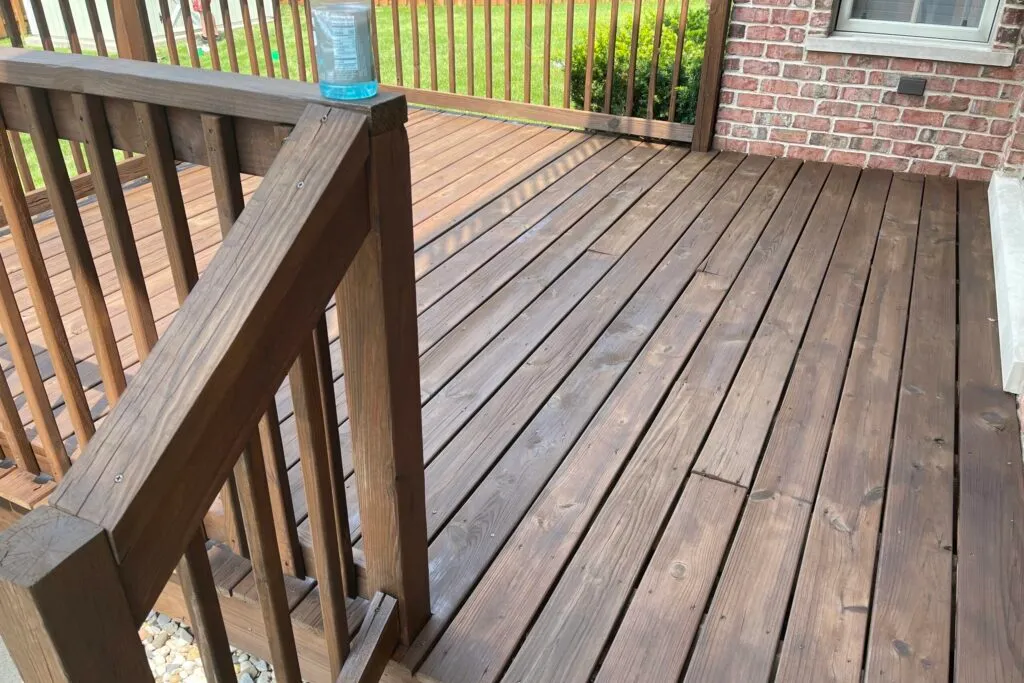
Do those three and a decent share of decks turn out to be perfectly fine until spring. We count that as a good outcome, not a lost sale.
When We Will Tell You Your Deck Does Not Need Staining
Plenty of the decks we look at in fall do not need a finish at all, and we will say so on the spot.
If your deck was properly stained within the last two years and water still beads on it, another coat will not help. Penetrating finishes need wood ready to absorb; oil over a still-sealed surface just leaves residue you have to clean off later. If you have true composite decking, traditional stain will not bond at all — the honest answer is a composite protectant or nothing.
And if the deck is genuinely failing — soft joists, a ledger pulling away from the house, posts that move when you lean on them — stain is cosmetic and beside the point. About four out of five decks we inspect can be fully restored rather than replaced, but that is a structural judgment, not something a coat of finish decides.
What We Book Instead When the Stain Has to Wait
Being turned down for staining does not mean we cannot help you before winter. Most of the work that genuinely protects a deck through a Chicago freeze-thaw season has nothing to do with cure temperature.
Board and fastener replacement, swapping out rotted decking, re-securing a ledger, rebuilding a stair stringer, deep cleaning to pull off mildew before it sets — all of that goes fine in cold weather. Doing it in fall means your deck rides out the winter structurally sound and is ready for finish the day spring opens up, instead of joining the queue behind everyone who waited. The same logic covers fence restoration and porch restoration, where post re-setting, picket replacement and step rebuilds are all cold-weather work.
Then when the weather turns, we come back and finish the job with Rymar Xtreme Weather, the penetrating oil stain-and-sealer we standardise on for cedar, pressure-treated pine and fences.
What Late-Season Work Actually Costs With Us
We publish our numbers because guessing helps nobody. Deep cleaning and mildew removal runs $0.50–$1.50 per square foot. Sanding and refinishing runs $2.00–$6.00 per square foot. Minor repairs to boards and fasteners land between $50 and $500, larger joist or post work between $300 and $2,000, and a full replacement starts around $3,000 and climbs from there — the full breakdown is in our deck restoration costs guide. Fence work is measured differently, at $3–$8 per linear foot to clean, sand and refinish both sides, with leaning posts re-set at $75–$250 each.
Those are real ranges, not teasers. We can stand behind them because we have been caring for Chicagoland decks since 2009 and back every project with our service guarantee. Every quote is a free on-site visit with no obligation — so if the answer turns out to be “wait until spring,” the visit still cost you nothing. From our base as your Glenview deck contractor we cover the North Shore and the western suburbs, and you can book a free estimate whenever it suits you.
Our Four Steps, and Why We Will Not Rush the Dry Time
Every job runs the same sequence: an inspection for rot, loose boards and hidden wear; cleaning and preparation with power washing, strippers and wood brighteners so new coats bond; repairs and sanding, where damaged boards get replaced and the surface comes back smooth; then stain, seal and a final walkthrough with a care guide.
The part homeowners underestimate is the waiting in between. George, Damir and Oleg will not put finish on a deck still holding water from the wash, and no amount of schedule pressure changes that. It is also why we are choosy about the products we use: a penetrating oil cannot flake or peel the way a film-forming coating does, so maintenance becomes a clean-and-recoat instead of a full strip. The USDA Forest Products Laboratory devotes a whole chapter on finishing wood to how sunlight, water and weathering act on wood and the finishes protecting it.
Your Late-Season Deck Checklist
- Clear leaves and debris off the boards every week or two through leaf-drop.
- Run the 30-second water test — beading means you can wait, soaking means the finish is spent.
- Sweep the gaps between boards clear so meltwater drains instead of freezing in place.
- Press on any board that feels spongy and pull on every railing and baluster.
- Move planters, furniture and rugs off the deck so nothing traps moisture all winter.
- Check the overnight lows, not the highs, before you commit to finishing anything.
- Book structural repairs now and finishing for spring if you are past the window.
- Plan the next coat properly by reading up on how often to restain and our full winter deck prep guide.
Frequently Asked Questions
What temperature is too cold to stain a deck? We use overnight lows, not daytime highs. Once the ten-day forecast shows nights below 45°F, we usually stop scheduling stain and seal work. It is not a hard wall — call us and we will check your actual forecast and boards first.
Is it too late to stain my deck in October in Chicago? It depends where you live. Weather Service normals put the first freeze at O’Hare on October 19 and Rockford on October 13. Homes near the lake get longer than homes further west. Early October is often workable, late October usually is not.
What happens if a deck gets stained when it is too cold? The oil sits on the surface instead of soaking in — tacky for days, easily marked, and vulnerable to the first rain. If the boards are damp, you seal water into the wood rather than keeping it out.
What deck work can you still do in cold weather? Most of it. Board and fastener replacement, rotted decking, ledger and joist repairs, stair and railing rebuilds and deep cleaning all go fine, because none of them depend on a finish curing.
If you are not sure which side of the line your deck falls on, that is the call worth making. We will look at your forecast and your boards and give you a straight answer — even when the answer is that it can wait until spring.